
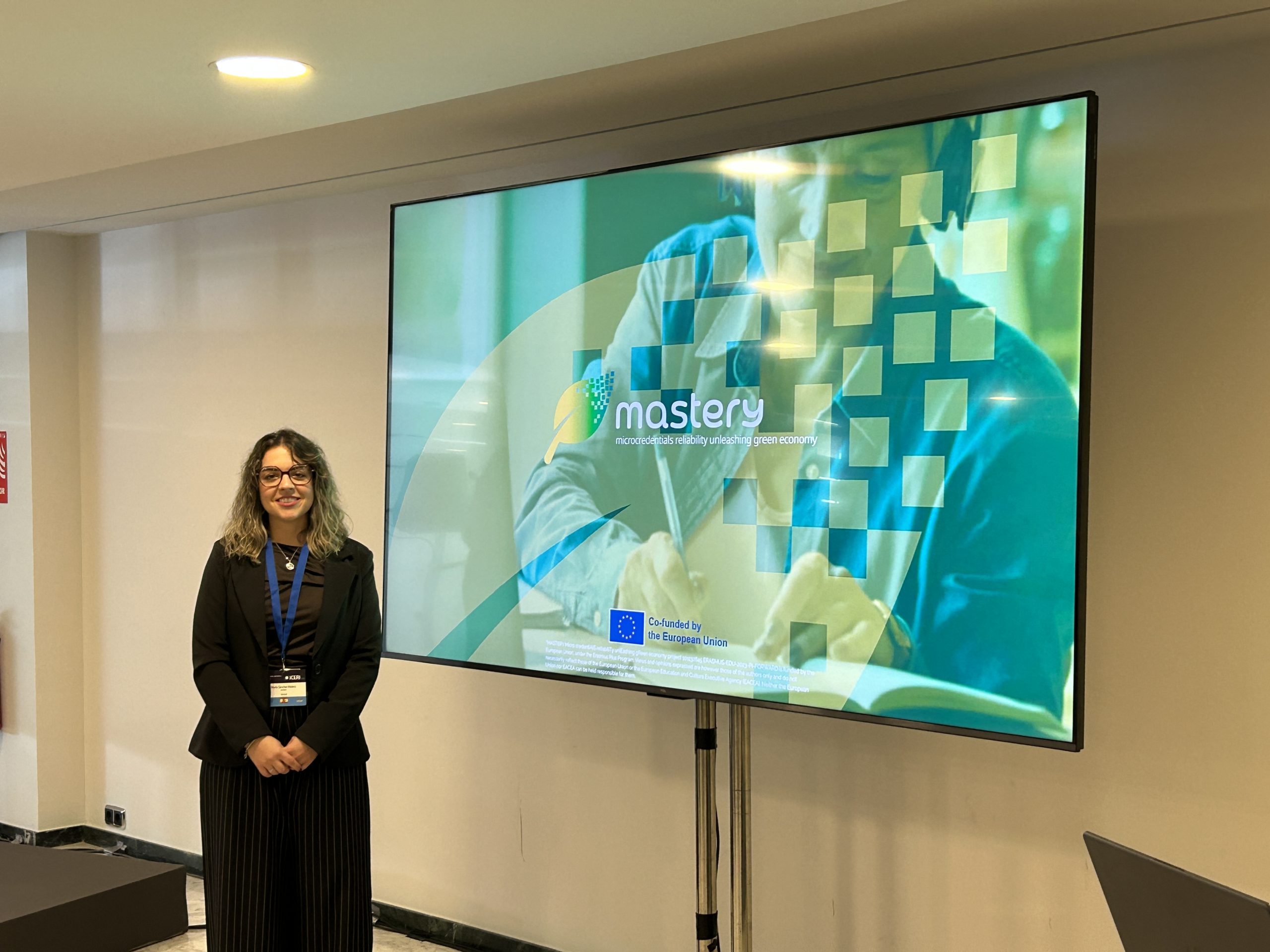
AMUEBLA represented the MASTERY project at ICERI2026, the 19th International Conference of Education, Research and Innovation, held in Seville, Spain, from 9 to 11 November 2026. The participation brought findings from the project’s Spanish pilots to an international audience of education professionals and researchers.
The contribution, jointly authored by AMUEBLA and CETEM, was entitled “Green Micro-credentials for Sustainable Skills: Lessons Learned from Three Pilot Experiences in Vocational Education and Adult Learning.” It examined how short learning pathways aligned with EQF levels 5–6 can support the development and recognition of green competences across different learning contexts.
Three learning pathways tested in Spain
The paper analysed three pilot experiences implemented between April and June 2026, involving 38 participants from vocational education, adult reskilling and social inclusion programmes. The pilots addressed three areas:
- Cradle-to-Cradle design for sustainable furniture production, exploring circular design, sustainable materials and product lifecycle considerations.
- Waste reduction and material efficiency, focusing on practical measures to prevent waste, reuse resources and improve material management.
- Circular, green and socially responsible procurement, introducing sustainability criteria into purchasing and supplier selection.
The learning pathways combined digital resources, trainer guidance, practical exercises and assessment adapted to the characteristics of each group. Across the three pilots, 31 participants obtained a micro-credential after successfully demonstrating the intended learning outcomes through practical assignments.
Practical assessment and tailored support
One of the main findings concerned the value of assessing how learners apply their knowledge to concrete situations. Assignments linked to furniture design, waste management and procurement provided opportunities to demonstrate green competences through familiar, relevant examples.
The pilots also highlighted that flexible formats and digital resources need appropriate support to be accessible. Clear language, contextualised activities, guidance from trainers and assistance with digital tools played an essential role, particularly for participants with limited educational or digital experience.
Cooperation between CETEM, AMUEBLA, VET providers and local support organisations helped connect the learning content with sector needs while responding to different learner profiles.
Informing future implementation
The Spanish experiences offer practical lessons for organisations interested in adopting green micro-credentials. These include assessing learners’ needs before delivery, preparing teachers and assessors, establishing transparent assessment criteria and combining local adaptation with common quality assurance principles.
Sharing these findings at ICERI2026 contributes to MASTERY’s wider dissemination of results and to the exchange of evidence on micro-credentials, sustainability education and lifelong learning.