
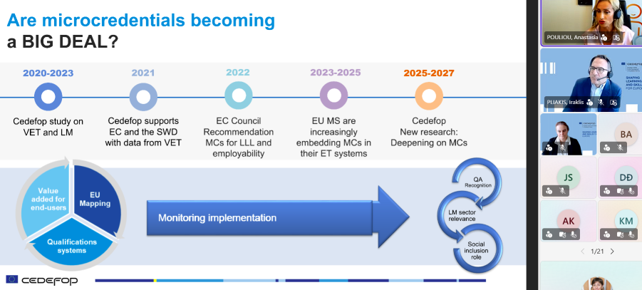
On 29 September 2026, the MASTERY consortium took part in Cedefop’s virtual event “Upskilling Europe: Microcredentials in action”, organised as part of the European Skills and VET Week.
The event brought together almost 300 participants, including policymakers, researchers, social partners, education and training experts, VET providers and industry representatives. The high level of participation confirmed the growing relevance of microcredentials as flexible tools to support lifelong learning, skills development, labour market responsiveness and social inclusion.
Key Messages from Cedefop
Cedefop presented findings on the diversity of microcredentials outside formal education and training, identifying different types of credentials, including education-system, regulatory, sectoral and occupational, employer and corporate, and provider-led market credentials.
One of the key messages of the event was that the value of a microcredential is closely linked to its intended purpose. Its credibility depends not only on recognition, but also on who stands behind it, how transparent it is, and whether it is supported by robust quality assurance mechanisms.
The discussions also highlighted that microcredentials are still mainly framed as tools for employment, upskilling and lifelong learning. At the same time, more evidence is needed on their uptake and impact among disadvantaged learners, especially if microcredentials are to fully contribute to inclusion and access to learning opportunities.
MASTERY: Testing Microcredentials in Practice
The insights shared during the webinar strongly resonate with the work carried out by MASTERY. Through its kick-start workshops in the five partner countries, the project has confirmed that effective microcredentials require close cooperation between VET providers, companies and HR professionals.
This collaboration is essential to identify the skills most urgently needed by the labour market and to ensure that training pathways respond to real skill gaps before they widen.
In the Italian pilot experience, for example, a key factor was the creation of common ground between VET providers and enterprises. This helped build learning pathways and certification processes that are credible for learners, relevant for companies and recognisable beyond the boundaries of a single organisation.
Two elements proved particularly important:
- the use of ESCO to reference skills and learning outcomes, creating a shared language between education and the world of work;
- the use of EQF referencing as a controlled and non-arbitrary process, supported by discussions with INAPP and linked to the importance of third-party assessment.
Within MASTERY, the consortium has designed 12 training courses based on microcredential-oriented learning design and certification, with the active involvement of companies throughout the process. The pilots have already started, with 130 microcredentials issued, confirming that the project approach goes beyond the digital badge itself.
For MASTERY, microcredentials are not only about issuing certificates. They are about ensuring transparency, quality, trust and recognition of learning outcomes.
Looking Ahead: Skills Portability and the European Agenda
The event also underlined the relevance of microcredentials in the context of the European agenda on skills, including the Union of Skills and the forthcoming Skills Portability Initiative.
For microcredentials to become truly portable, they need to be transparent, quality-assured and, where possible, connected to national qualifications frameworks and aligned with the 2022 Council Recommendation on a European approach to microcredentials.
This is precisely the logic tested by MASTERY in practice: referencing to ESCO and EQF, quality assurance, third-party assessment and company involvement are key ingredients to make microcredentials more understandable and transferable across organisations, sectors and borders.
As the pilots move towards their conclusion, MASTERY is now preparing to release its policy recommendations. The project will continue experimenting, refining its approach and engaging with national and transnational stakeholders, including countries in the European neighbourhood, to support microcredentials as real passports of skills for the future.