
Before a micro-credential can be issued, the quality of what happens in the classroom, or on screen, must meet a precise standard. This is why the Train the Trainers (TtT) phase sits at the heart of the MASTERY project: not simply to update educators on green skills content, but to equip them with the specific methodologies and assessment tools required to deliver training that qualifies for micro-credential certification.
The educators and professionals who took part in the TtT sessions were already subject-matter experts. The focus of these sessions was therefore not on content alone, but on the MASTERY methodology: how to structure evidence-based assessment, how to guide learners through practical project work, how to manage blended learning environments, and critically how to apply the process for issuing micro-credentials in compliance with European standards.
MASTERY’s micro-credentials are designed in full alignment with the EU Council Recommendation on micro-credentials (2022). Trainers were introduced to what this means in practice across the key principles that MASTERY directly addresses:
Each MASTERY course runs under 30 hours and is built around clearly defined learning outcomes, meeting the EU’s common definition of a micro-credential as a short, targeted learning experience. Courses are pegged at EQF level 5, opening access to workers already in employment, those re-entering the labour market, and learners seeking to keep pace with sustainable innovation, in line with the lifelong learning objective. Course content was co-designed with enterprises across the wood, agri-food, construction, manufacturing, and public administration sectors, ensuring the occupability focus is built in from the start, not added as an afterthought.
On quality and transparency, MASTERY’s micro-credentials have been validated by the World Alliance for Microcredentials, an international body with recognised expertise from Europe to Australia. All courses are referenced against ESCO for transnational skills traceability, and VET providers apply EQAVET and ECVET standards throughout delivery and recognition. The 12 micro-credentials are modular and composable: learners can take a single course or build a personalised pathway combining sector-specific and transversal skills, including sustainability reporting and EU regulatory compliance, fully in line with the flexibility and learner-centred principles of the Recommendation.
Accessibility is guaranteed through the MASTERY Academy, an open platform with no participation or certification costs. Digital credential security is handled through MICOO, a blockchain-based infrastructure that authenticates both the credential content and the identity of the recipient. Finally, formal and non-formal VET actors from Italy, Bulgaria, Spain, and Finland are working towards mutual recognition of all 12 MASTERY micro-credentials, some concrete, if initial, step towards the cross-border and cross-sector recognition that the Recommendation calls for.
Trainers are now equipped to deliver all of this, not just the content, but the full certification journey.
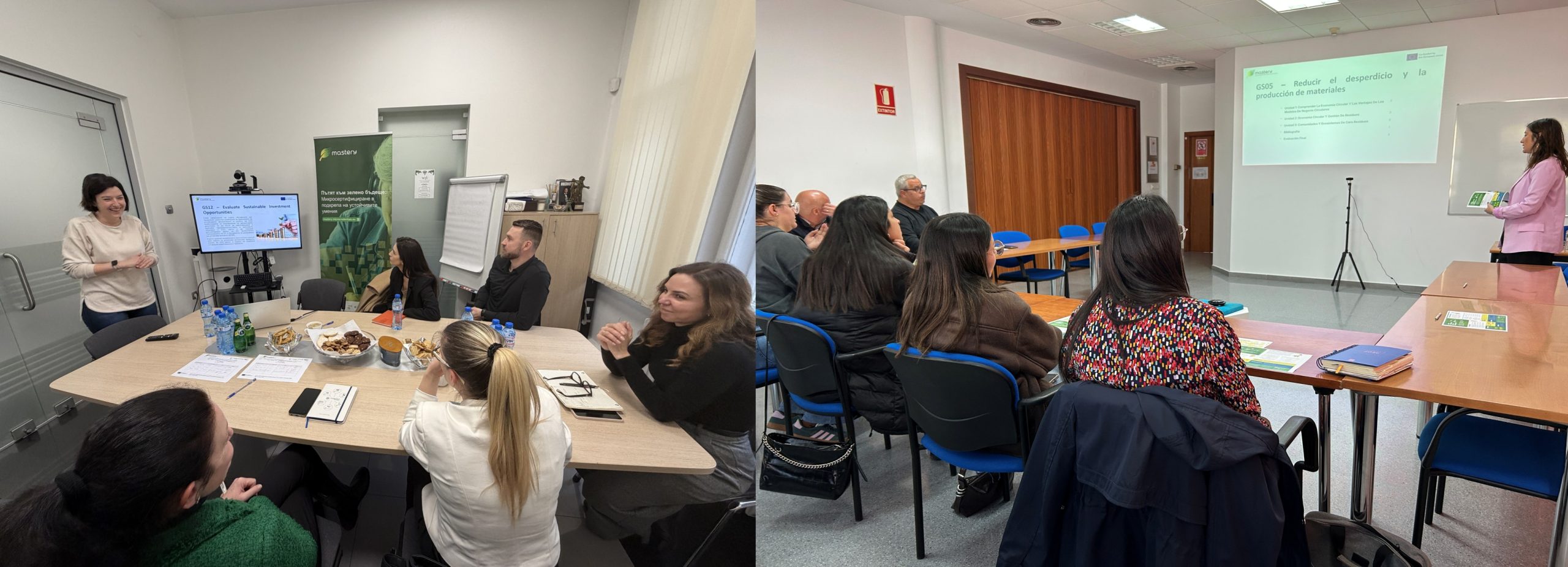
In Spain, CETEM and AMUEBLA organised their Train the Trainers session on 16 March 2026, bringing together VET teachers and professionals from the wood and furniture sector, as well as organisations working with diverse target groups. These trainers are now actively involved in delivering pilot courses on circular design, waste reduction and sustainable procurement.
In Bulgaria, CTBG and KRIB held their TtT session on 30 March 2026, preparing trainers for the delivery of courses focused on environmentally friendly construction materials, sustainability initiatives and sustainable investment. The session focused on familiarizing the participants with the MASTERY paradigm, laying the basis for successful piloting of the green skills courses starting in April 2026.
In Italy, the training of trainers held on 9 April brought together educators from both formal education (universities and bodies awarding professional qualifications) and informal education (VET providers working closely with businesses to update corporate skills profiles). Discussions on how to integrate MASTERY micro-credentials into training activities received strong support and input from AMUEBLA, offering teachers further food for thought on the opportunities that MASTERY opens up, including transnational ones.
In Finland, PJI arranged the Training the trainers (TtT) session on 26 March 2026. The event brought together course providers in the agri-food sector, teachers, and specialists in sustainability and green skills. The main topic was to exchange views on experiences with Mastery methodology and the course platform.
By investing in trainer capacity at this level of methodological depth, MASTERY is contributing to something larger than a set of pilot courses. It is helping to build a VET ecosystem better equipped to read, develop, and certify the strategic competences that European labour markets increasingly demand, precisely the ambition at the core of the Union of Skills framework. Each trained educator becomes a node in that system: capable of delivering quality-assured, micro-credentialled green skills training that is transparent, portable, and recognised across borders.